Customer service
Ultimate guide to Tomos moped tires: tire sizes, tire types and maintenance
Good tires make your Tomos safer, more stable and more enjoyable to ride. Whether you ride every day, have a sporty setup or occasionally ride off-road, choosing the right moped tire starts with understanding the size, Load Index, Speed Index and DOT code.
In this guide, we explain how to read Tomos tire sizes, how inch sizes and metric sizes compare, which types of moped tires are available and how to check and maintain your tires.
How to read Tomos tire sizes
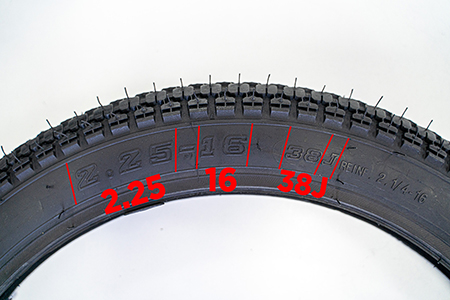
The size of a moped tire is printed on the sidewall. This number tells you the tire width, tire height and rim size. Sometimes the size is written in inches, for example 2.25-16. Sometimes it is written as a metric size, for example 90/100-16.
With an inch size such as 2.25-16, 2.25 is the tire width and 16 is the rim size in inches. With a metric size such as 90/100-16, the first number is the width in millimeters, the second number is the tire height as a percentage of the width and the third number is again the rim size in inches.
Tire size overview: inch to metric
The table below gives a practical comparison between common inch sizes and approximate metric sizes. The conversion is approximate because the real tire width and height can vary slightly by brand and model.
| Inch size | Approx. metric size | Practical note |
|---|---|---|
| 3.00 x 12 | 80/90-12 | Common small rim size |
| 4.75 x 12 | 120/70-12 | Wide 12 inch tire |
| 2.25 x 16 | 60/90-16 | Narrow 16 inch moped tire |
| 2.50 x 16 | 70/90-16 | Common Tomos tire size |
| 2.75 x 16 | 80/90-16 | Wider than standard; check clearance |
| 2.00 x 17 | 50/90-17 | Narrow 17 inch tire |
| 2.25 x 17 | 70/90-17 | Common 17 inch size |
| 2.50 x 17 | 70/90-17 | Common 17 inch size |
| 2.75 x 17 | 80/90-17 | Wide 17 inch tire |
| 3.00 x 17 | 90/90-17 | Extra wide 17 inch tire |
Old tire size markings
On older tires and in older brochures, you may find unusually large-looking size markings. This is because a different sizing method was used at the time. The table below shows common older markings and their current equivalents.
| Current size | Old marking | Note |
|---|---|---|
| 2.00 x 16 | 20 x 2.00 | Old 16 inch notation |
| 2.25 x 16 | 20 x 2.25 | Old 16 inch notation |
| 2.75 x 17 | 21 x 2.75 | Old 17 inch notation |
| 2.00 x 17 | 21 x 2.00 | Old 17 inch notation |
| 2.00 x 19 | 23 x 2.00 | Old 19 inch notation |
| 2.25 x 19 | 23 x 2 x 2.25 | Old 19 inch notation |
| 2.50 x 19 | 23 x 2 x 2.50 | Old 19 inch notation |
Mounting a wider tire on your Tomos
Want to mount a wider tire than the original one? This is sometimes possible, as long as the rim size stays the same and there is enough clearance at the front fork, swingarm, fenders and shock absorbers. Do not simply choose the widest tire possible: a tire that is too wide can rub and may make the moped handle worse.
Load Index, Speed Index and DOT code
Besides the tire size, the sidewall also contains information about maximum load, maximum speed and production date. These markings are important when choosing a safe and suitable tire for your Tomos.
Maximum weight and speed
The Load Index (LI) shows how much weight the tire can carry. The Speed Index (SI) shows the maximum speed rating of the tire. You often see this as a combination of a number and a letter, for example 28L. In that example, 28 means 100 kg load capacity and L means 120 km/h.
Load Index table
| LI | KG |
|---|---|
| 0 | 45 |
| 1 | 46.2 |
| 2 | 47.5 |
| 3 | 48.7 |
| 4 | 50 |
| 5 | 51.5 |
| 6 | 53 |
| 7 | 54.5 |
| 8 | 56 |
| 9 | 58 |
| 10 | 60 |
| 11 | 61.5 |
| 12 | 63 |
| 13 | 65 |
| 14 | 67 |
| 15 | 69 |
| 16 | 71 |
| 17 | 73 |
| 18 | 75 |
| 19 | 77.5 |
| LI | KG |
|---|---|
| 20 | 80 |
| 21 | 82.5 |
| 22 | 85 |
| 23 | 87.5 |
| 24 | 90 |
| 25 | 92.5 |
| 26 | 95 |
| 27 | 97 |
| 28 | 100 |
| 29 | 103 |
| 30 | 106 |
| 31 | 109 |
| 32 | 112 |
| 33 | 115 |
| 34 | 118 |
| 35 | 121 |
| 36 | 125 |
| 37 | 128 |
| 38 | 132 |
| 39 | 136 |
| LI | KG |
|---|---|
| 40 | 140 |
| 41 | 145 |
| 42 | 150 |
| 43 | 155 |
| 44 | 160 |
| 45 | 165 |
| 46 | 170 |
| 47 | 175 |
| 48 | 180 |
| 49 | 185 |
| 50 | 190 |
| 51 | 195 |
| 52 | 200 |
| 53 | 206 |
| 54 | 212 |
| 55 | 218 |
| 56 | 224 |
| 57 | 230 |
| 58 | 236 |
| 59 | 243 |
Speed Index table
| SI | KM/H |
|---|---|
| B | 50 |
| C | 60 |
| D | 65 |
| E | 70 |
| F | 80 |
| G | 90 |
| J | 100 |
| K | 110 |
| L | 120 |
| M | 130 |
| SI | KM/H |
|---|---|
| N | 140 |
| P | 150 |
| Q | 160 |
| R | 170 |
| S | 180 |
| T | 190 |
| U | 200 |
| H | 210 |
| V | 240 |
| W | 270 |
Reading the manufacturing date with the DOT code
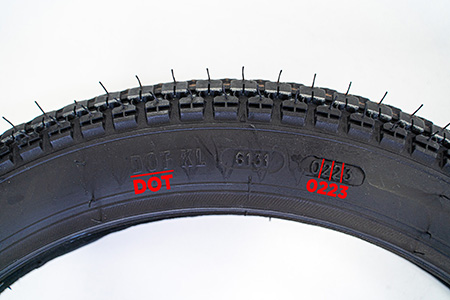
Every moped tire has a DOT code. This code tells you when the tire was produced. The production date is usually shown as four digits. The first two digits are the production week and the last two digits are the production year.
A DOT code such as 0223 means the tire was produced in week 2 of 2023. As a general guideline, you should inspect tires carefully after 5 to 6 years and replace them sooner if they are dried out, cracked, deformed or clearly worn.
Types of Tomos moped tires
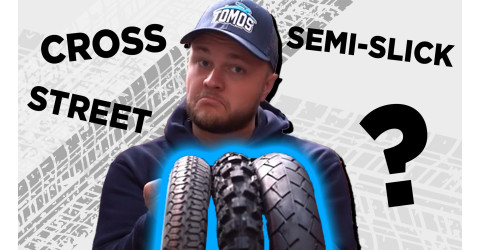
Moped tires can be divided into three main categories: sport tires or semi-slicks, cross tires and street tires. The difference is mainly in the tread pattern and rubber hardness. Each type behaves differently in dry weather, rain, sand, mud and daily street use.
| Tire type | Best use | Advantage | Disadvantage |
|---|---|---|---|
| Semi-slick / sport tire | Sporty riding and dry conditions | Large contact patch and strong grip in dry conditions | Wears faster and clears less water in wet conditions |
| Cross tire | Loose surfaces, sand, mud and mopedcross | Deep tread and strong off-road grip | Wears faster on asphalt and feels less precise on the street |
| Street tire | Daily street use | Good balance between grip, wear and control | Less specialized than a true sport tire or cross tire |
Sport tires and semi-slicks
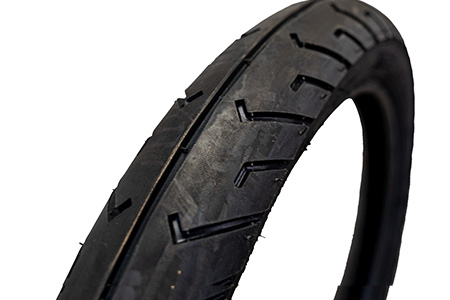
Sport tires have little tread and are relatively smooth. This gives the tire more contact with the road surface. The rubber is often softer, helping the tire warm up and provide more grip during dry, sporty riding.
The downside is that this type of tire wears faster and gives less grip on wet roads. True slicks have no tread at all and are intended for dry circuits. Semi-slicks with the correct road approval can be suitable for public road use.
Cross tires
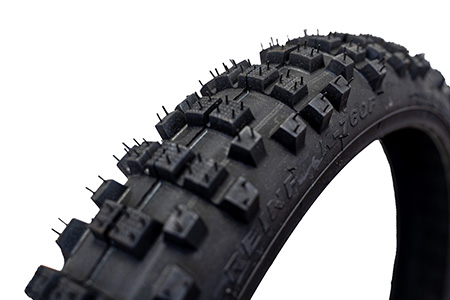
Cross tires are on the other side of the spectrum. They have deep tread and are designed to find grip on loose surfaces. They work well in sand, mud and grass, for example during mopedcross.
On asphalt, cross tires behave differently. The deep tread moves more, the tire can wear faster and cornering feels less sharp than with a normal street tire. If you want to use a cross tire on the road, always check whether the tire has the correct approval marking.
Street tires
For normal street use, a street tire is usually the best choice. A good street tire gives a solid balance between grip, lifetime, water drainage and handling. Some tires have a lower profile for summer use, while others have deeper tread for wet or colder conditions.
If you do not want to change tires between seasons, an all-season tire can be a practical choice. This type of tire usually has enough tread to clear water and dirt while remaining suitable for daily use in different conditions.
Tire maintenance and replacement
Good tire maintenance prevents many problems. You do not want your Tomos to handle poorly, lose grip unexpectedly or get a flat tire while riding. Check your tire pressure, tread, cracks and general tire condition regularly.
Checking tire pressure
Before riding, squeeze your tires and check that they have not gone soft. A tire with too little pressure handles poorly, runs hotter, wears faster and is more likely to get damaged. For a standard tire size such as 2.25-16, around 2 bar is often a good starting point. Always check what suits your tire, rim, rider weight and riding style.
Checking tread and wear
Check the tread across the full contact surface. As a practical workshop guideline, we recommend not riding with less than about 1 mm tread depth. Also look for uneven wear, flat spots, dry cracks, bulges or deformation.
Shallow or dried-out tread clears water less effectively and gives less grip on wet roads. The chance of a puncture also increases when there is little rubber left or when the tire is old and dry.
Conclusion
When you know how to read the tire size, Load Index, Speed Index and DOT code, you can choose the right tire for your Tomos much more easily. For daily use, a good street tire is usually the best choice. For sporty dry riding, a semi-slick can be interesting, while cross tires are mainly suitable for loose surfaces.
Check your tires regularly and replace them when they are worn, dried out or damaged. With the right tires and proper maintenance, your Tomos will ride safer, more stable and with more confidence.
Ride safely and have fun on two wheels!
Back to topFAQ: Tomos moped tires
How do I read the tire size on my Tomos tire?
The tire size is printed on the sidewall. With a size such as 2.25-16, 2.25 is the tire width and 16 is the rim size in inches. With a size such as 90/100-16, 90 is the width in millimeters, 100 is the height as a percentage of the width and 16 is the rim size.
Which tire should I choose for normal street use?
For normal street use, a street tire is usually the best choice. It gives a good balance between grip, wear, water drainage and handling.
Can I mount a wider tire on my Tomos?
Sometimes, yes. The rim size must stay the same and there must be enough clearance at the front fork, swingarm, fenders and shock absorbers. On many Tomos setups, do not go wider than 2.75 without checking carefully because the tire may rub.
When should I replace my Tomos outer tire?
Replace the outer tire when the tread is too worn, when the tire has cracks or deformation, when it loses air or when it is old and dried out. After 5 to 6 years, it is smart to inspect moped tires extra carefully.
What tire pressure is suitable for a Tomos moped?
For a standard tire size such as 2.25-16, around 2 bar is often a good starting point. The correct pressure depends on your tire, rim, rider weight and riding style.