Customer service

Check your Tomos ignition: no spark, weak spark or poor starting
The ignition is the heart of your Tomos. Without a good spark, your moped will not start, may run unevenly or may cut out as soon as you open the throttle. In this guide we explain step by step how a Tomos ignition works, which parts commonly cause problems and how to trace the fault logically.
This guide is useful for Tomos A3, A35, A52 and A55 riders who want to measure, test and repair their own ignition system. You will learn how to check the spark plug, spark plug cap, spark plug lead, kill switch, wiring harness, CDI/coil, stator and flywheel with basic workshop checks and a multimeter.
How does a Tomos ignition work?
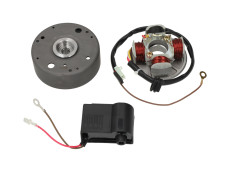
The ignition path on your Tomos starts with the ignition. The flywheel rotates around the stator coils. The magnets inside the flywheel generate voltage as they pass the coils. That voltage goes to the CDI/coil unit, where the ignition pulse is built.
The coil converts this low voltage into high voltage. That high voltage travels through the spark plug lead and spark plug cap to the spark plug. There the spark jumps across the electrodes. If one part of this chain fails, you can get no spark, a weak spark or an irregular spark.
| Part | Function | Typical fault | What should you check? |
|---|---|---|---|
| Flywheel | Spins magnets around the stator coils | Loose flywheel, damaged key or weak magnets | Tightness, key, timing and damage |
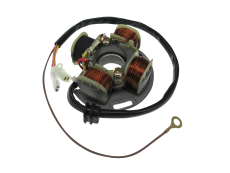
| Stator / ignition coils | Generates voltage for the ignition | No voltage or voltage too low | AC voltage and wiring from the ignition |
| CDI/coil unit | Controls the pulse and creates high voltage | No spark or irregular spark | Resistance, corrosion, moisture and burn marks |
| Spark plug lead and cap | Carries high voltage to the spark plug | Leakage, poor connection or broken lead | Resistance, insulation and visual damage |
| Spark plug | Creates the spark inside the cylinder | Worn, wet, fouled or wrong electrode gap | Colour, condition, gap and spark test |
| Kill switch and wiring harness | Switches the ignition off by grounding it | Stays grounded or has a broken wire | Continuity, ground and connectors |
Quick diagnosis for no spark on your Tomos
Always work from simple to complex. Replace or test the spark plug first, then check the spark plug cap and lead, rule out the kill switch and only then start measuring deeper parts such as the CDI/coil and ignition.
| Symptom | Likely cause | First test | Next step |
|---|---|---|---|
| No spark at all | Spark plug, kill switch, ground, CDI/coil or stator | Test with a new or known working spark plug | Rule out the kill switch and measure the ignition |
| Weak yellow spark | Bad spark plug, plug cap, lead or coil | Check spark plug gap and plug cap | Replace the lead/cap or test the CDI/coil |
| Spark disappears when moving wires | Broken wire or bad connector | Measure continuity with a multimeter | Repair wiring harness or replace connector |
| Engine starts sometimes, then cuts out | Poor ground, loose stator plate, faulty CDI or wrong timing | Check ground and flywheel/stator plate mounting | Measure ignition and CDI/coil |
| Wet spark plug after repeated kicking | No spark or too much fuel | Dry/replace spark plug and perform spark test | Test ignition and check carburettor setup |
Check the Tomos kill switch and wiring harness
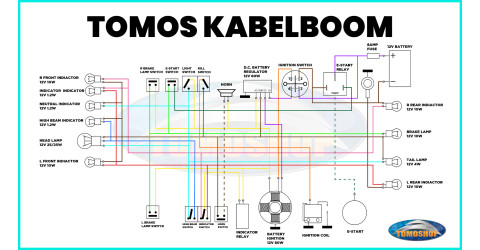
A faulty kill switch can permanently ground the ignition. When that happens, your Tomos will not make a spark, even if the spark plug, coil and ignition are otherwise good. Loose wires, poor connectors, corrosion and broken wires in the harness can also interrupt the spark.
How do you recognise a faulty kill switch or broken wire?
Does your Tomos have no spark while the kill switch is in the run position? Or does the spark disappear when you move the wires near the handlebar, steering head or frame? Then the problem is often in the kill switch, ground, connectors or wiring harness. Also look for green corrosion, loose plugs, cracked insulation and places where the wires rub against the frame.
How do you test the kill switch with a multimeter?
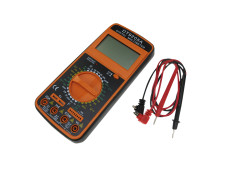
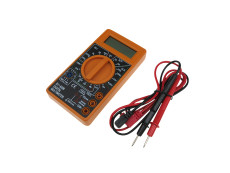
- Set your multimeter to continuity or low ohms.
- Hold one probe against a clean ground point on your Tomos.
- Hold the other probe against the output wire of the kill switch.
- In the stop position, the kill switch should make contact with ground.
- In the run position, the kill switch should not make contact with ground.
- Then measure the wires from end to end. If you hear no beep or see no continuity, you probably have a broken wire.
View all Tomos kill switches and electrical parts for your wiring harness.
Back to topTest the Tomos spark plug, spark plug lead and cap
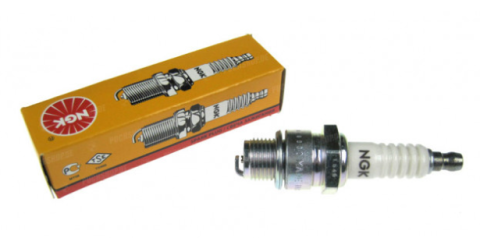
The spark plug, spark plug lead and plug cap are small parts, but they often cause major ignition problems. A worn spark plug, bad cap or broken lead can cause no spark, a weak spark or a spark that jumps to the frame instead of the plug.
Recognising problems from the spark plug
| Spark plug appearance | What does it mean? | Possible cause | What should you do? |
|---|---|---|---|
| Black and sooty | The engine is probably running too rich | Main jet too large, too much oil or poor combustion | Check setup and clean/replace the spark plug |
| White or very light | The engine may be running too lean | Main jet too small, air leak or not enough fuel | Do not keep riding; check carburettor and air leaks |
| Wet | Fuel is not being ignited properly | No spark, weak spark or flooded engine | Dry/replace the spark plug and perform a spark test |
| Worn electrode | Spark becomes weaker or irregular | Old spark plug or wrong spark plug | Replace the spark plug and check the gap |
How do you test a spark plug for spark?
- Remove the spark plug from the cylinder head.
- Check the electrode gap. For many Tomos setups, around 0.45 mm is a good starting point.
- Put the spark plug back into the spark plug cap.
- Hold the thread of the spark plug against a clean ground point on the engine.
- Kick the engine over. Do you see a clear blue spark? Then the spark plug is probably working well.
- If you see no spark, test with another spark plug to rule out the plug itself.
Check the spark plug lead and cap
A bad spark plug lead or cap can break internally, hold moisture or leak current. Then the spark does not jump cleanly at the plug, but disappears through the lead, cap or frame.
- Visually check the spark plug lead for cracks, hard spots and damaged insulation.
- Set the multimeter to resistance (Ω).
- Measure between the copper core of the spark plug lead and the contact point inside the plug cap.
- If you get no normal resistance reading or no connection at all, the cap or lead is suspect.
- Also check for unwanted continuity to ground. Continuity to ground often means current leakage or damaged insulation.
View all Tomos spark plugs. Want to know more about plug types, resistance and short or long reach? Also read our blog: explaining different spark plugs for Tomos.
Back to topCheck the Tomos CDI, coil, stator and flywheel
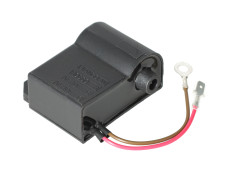
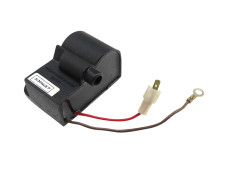
If the spark plug, plug cap, spark plug lead, ground and kill switch are all good, go deeper into the ignition path. On many Tomos A35 and A55 models, the CDI and coil are combined in one unit. This unit processes the ignition pulse and creates the high voltage for the spark plug.
How do you recognise a faulty CDI/coil unit?
A faulty CDI/coil unit often causes no spark, a weak spark or a spark that drops out irregularly. Sometimes the engine runs reasonably when cold, but cuts out when warm. Always check the connectors, ground, moisture, corrosion and visible burn marks first.
How do you measure the CDI/coil unit?
- Disconnect the CDI/coil unit from the wiring harness.
- Set your multimeter to Ohms (Ω).
- Measure between the CDI/coil input and ground.
- Then measure between the coil spark output and ground.
- An infinite reading (OL) often points to a broken winding or wire break.
- A reading of 0 Ω often points to a short inside the coil.
Measure the stator and ignition
The stator and coils generate voltage as soon as the flywheel rotates. You can use a multimeter to check whether AC voltage is being generated while kickstarting.
- Set the multimeter to AC voltage.
- Measure between the ignition wire and ground while kicking the engine over.
- You should see a fluctuating voltage while the flywheel rotates.
- If you see no voltage or extremely low voltage, a coil, wire or ground connection may be faulty.
Check the flywheel, stator plate and flywheel key
The flywheel must be securely fastened. A loose flywheel, shifted stator plate or damaged flywheel key can disturb the ignition timing. This can make your Tomos run poorly, refuse to start or cut out irregularly.
- Check that the flywheel nut is tight.
- Check that the stator plate is tight and has not shifted.
- Check that the stator plate is set to the correct snor or brom position.
- Check that the flywheel key is not bent, worn or broken.
View all Tomos ignitions and parts for your ignition system.
Back to topFAQ: Tomos ignition and no spark
What should I check first if my Tomos has no spark?
Start with the simple parts: spark plug, spark plug cap, spark plug lead, ground connection and kill switch. First test with a good spark plug. Then rule out the kill switch and wiring harness before measuring the CDI/coil or stator.
How do I test the kill switch on my Tomos?
Set your multimeter to continuity. In the stop position, the kill switch should connect to ground. In the run position, there should be no connection to ground. If it keeps grounding the ignition, your Tomos cannot make a spark.
What spark plug gap does a Tomos need?
For many Tomos setups, around 0.45 mm is a good electrode gap. Always check that the spark plug is clean, dry and not worn. The wrong gap can cause a weak or irregular spark.
How do I know if my Tomos CDI or coil is faulty?
A faulty CDI/coil often gives no spark, a weak spark or a spark that drops out. Check connectors, ground, spark plug lead and plug cap first. If you measure OL, 0 Ω, a clear short, corrosion or visible damage, the CDI/coil unit is suspect.
Can a loose flywheel stop my Tomos from starting?
Yes. A loose flywheel, shifted stator plate or damaged flywheel key can disturb the ignition timing. This can make your Tomos start poorly, run unevenly or fail to produce a reliable spark.